
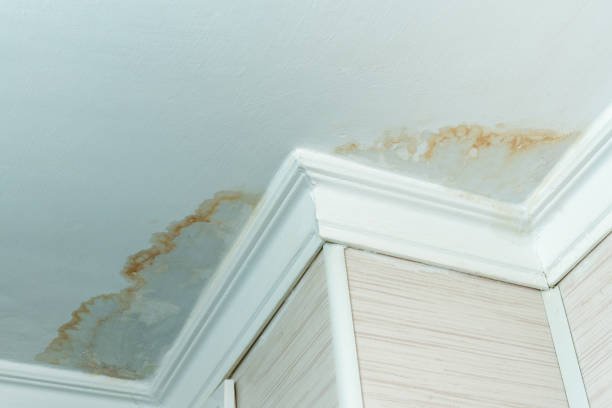
A ceiling water stain often appears far from the actual roof leak because water rarely drips straight down once it enters a roof.
Instead, it follows the path of least resistance along rafters, roof decking, insulation, and framing until gravity or an obstruction finally pulls it through the ceiling below, sometimes several feet from where it first got in.
This is one of the most common points of confusion we see among homeowners across New Jersey, and understanding how water actually moves through a roofing system is the first step toward finding the true source rather than repairing the wrong spot.
Water Does Not Fall in a Straight Line
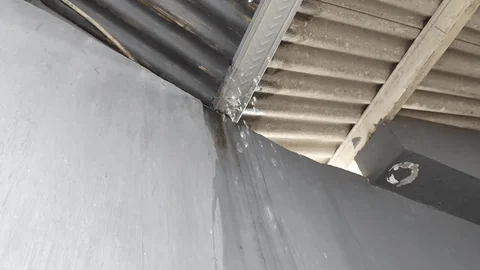
It’s natural to assume the stain on your ceiling sits directly beneath the opening in your roof. In reality, a roof is built from layered materials, including shingles, underlayment, decking, framing, and insulation, and water moves along these layers before it becomes visible indoors.
Once moisture gets past the outer roofing surface, it clings to wood, runs along the underside of the deck, tracks down a rafter, or spreads across insulation until it reaches a point where it can finally drip through drywall.
Common Paths Water Travels Before You See It
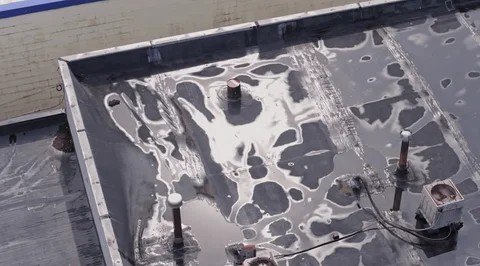
Along the Roof Decking and Rafters
Water entering near a valley, ridge, or roof transition can travel a considerable distance across the underside of the decking before dropping at a low point, such as a nail head, a seam, or a dip in the framing.
Through Insulation
Attic insulation acts like a sponge. Water can soak into it near the entry point and slowly migrate outward, meaning the visible stain may be nowhere close to where the moisture first landed.
Along Framing and Structural Members
Rafters, trusses, and ceiling joists give water an easy channel to follow. Moisture often rides along these wood members horizontally before finding a gap, such as around a light fixture or a seam in the drywall, where it can finally exit.
Around Fixtures and Penetrations
Recessed lighting, ceiling fans, and HVAC ducts create small openings in the ceiling barrier. Water traveling through the attic space frequently finds these penetrations first, which is why a stain often appears near a light fixture even when the true entry point is several feet away on the roof.
Why the Roof Slope Makes This Worse

On a sloped roof, gravity pulls water downhill along the roof deck and framing rather than straight down through the structure.
A leak near the ridge can travel a long way down the slope before it ever reaches a spot where it drips into living space.
This is one reason a stain near an exterior wall might actually trace back to a roof penetration much higher up and further inward.
Typical New Jersey Roof Entry Points
Certain roof features are far more likely to let water in than the open field of shingles, including:
- Chimney flashing and step flashing along roof-to-wall transitions.
- Valleys where two roof planes meet.
- Skylight curbs and seals.
- Vent boots around plumbing stacks.
- Ice dams that form along the roof edge during New Jersey winters and force melting snow beneath shingles.
Because these features are often located away from the interior stain, homeowners frequently search the wrong area first.
How to Read the Clues Correctly
Check the Timing
A stain that grows during or shortly after rain points toward an active roof leak. One that appears mainly after a cold, clear night may actually be attic condensation rather than a leak at all, which is a separate issue with a different fix.
Look Above and Beyond the Stain
Instead of only checking the ceiling directly above a stain, trace upward and outward across the attic. Follow rafters and decking outward from the visible drip point toward the nearest roof penetration, since that is usually where the real entry sits.
Watch the Stain Shape
Leak-related stains often form with a defined ring or edge and tend to darken or expand after rainfall. Softer, spread-out staining with no clear edge may point toward condensation or a slow, ongoing moisture source rather than a single leak point.
Note What’s Directly Overhead
Bathrooms, kitchens, and HVAC lines above a stained ceiling can introduce a separate source of moisture entirely, such as a condensate line or exhaust duct, which is worth ruling out before assuming the roof itself is the cause.
Why Professional Roof Leak Detection Matters
Because moisture can travel several feet through decking, framing, and insulation before it appears indoors, visual guesswork from inside the attic or from the ceiling alone often leads to the wrong repair.
A thorough inspection traces the moisture trail methodically, checking flashing, valleys, penetrations, and decking condition alongside the stain pattern itself to confirm the actual origin point before any work begins.
This approach protects homeowners from paying for a repair in the wrong location while the true opening keeps letting water in.
Related: Why Does My Roof Keep Dripping After the Rain Has Already Stopped?
Why Local Roofing Knowledge Matters in New Jersey
New Jersey homes deal with a demanding mix of summer humidity, coastal storm systems, and winter freeze-thaw cycles that all affect how and where water moves through a roof assembly.
Roof slopes, valley placement, chimney styles, and attic construction vary widely across the state’s older and newer housing stock, which means tracing a leak correctly requires familiarity with how local roofs are actually built.
We are the most experienced roof leak repair team in New Jersey, and that regional background is what allows an accurate trace back to the true entry point rather than a guess based on where the stain happens to sit.
Related: Attic Condensation or Roof Leak? How NJ Homeowners Can Tell the Difference
Frequently Asked Questions
Can a roof leak travel more than a few feet before showing up on the ceiling?
Yes. Depending on the roof slope, framing layout, and insulation, water can travel several feet, and in some cases across an entire section of attic, before it finds a path through the ceiling.
Does a bigger stain always mean a bigger leak?
Not necessarily. A small, steady leak that has been active for a long time can create a large stain, while a sudden but minor entry point may only produce a small mark. Size alone does not confirm severity.
Why does my stain only show up after heavy rain?
This usually points toward a leak tied to a specific roof feature, such as a valley or flashing point, that only becomes overwhelmed during periods of heavier or prolonged rainfall.
Is it possible the ceiling stain isn’t from the roof at all?
Yes. Attic condensation, HVAC condensate lines, and even plumbing from an upper floor can all produce similar-looking ceiling stains, which is why confirming the source before repair is so important.
Should I open the ceiling to find the leak myself?
It’s best to trace the moisture path through the attic first, since opening drywall without confirming the true source can lead to unnecessary repair work in the wrong location.