 Skip to content
Winter roof leaks in New Jersey are most commonly caused by ice dams, heavy snow load, and freeze-thaw cycles that force water under shingles, crack flashing seals, and exploit every small vulnerability your roof already has, turning a minor issue into an active leak within a single cold season.
New Jersey winters are brutal on roofs in a way that’s unique to this region. You’re not dealing with the sustained deep freeze of upstate New York, where snow stays frozen and stable.
You’re dealing with a climate that swings between 12°F and 50°F within the same week, freezing, melting, refreezing, over and over, from November through March. That cycle is relentless, and it finds weaknesses in roofs that would otherwise stay dry through a warmer winter.
This guide covers every major winter leak in NJ, how to recognise each one, what the damage looks like inside your home, and what to do about it before spring reveals the full extent of the problem.
This guide covers every major winter leak in NJ, how to recognise each one, what the damage looks like inside your home, and what to do about it before spring reveals the full extent of the problem.
That’s why many homeowners rely on NJ Roof Leak Experts, known for offering some of the best roof leak repair services in New Jersey.
Why New Jersey Winters Are Especially Hard on Roofs?
Most roofing materials are designed to handle temperature extremes, but they’re stressed by rapid, repeated change more than by sustained cold. Here’s what NJ’s specific climate does to a roof:
Asphalt shingles contract in cold and expand in heat. Through an NJ winter with 20 or 30 freeze-thaw cycles, shingle edges lift, crack, and lose granules at an accelerated rate. Seals between shingles that were holding fine in October may fail by February.
Flashing sealants, the caulk and butyl tape around chimneys, vents, and skylights shrink in cold weather. A seal that looked intact in the fall can develop a gap just wide enough to let water in after the first hard freeze.
Roof decking expands and contracts with moisture changes. In a wet NJ winter, this movement stresses the nails holding shingles down, slowly backing them out and loosening the hold.
Ice is the real wildcard. No other climate factor puts the same kind of sustained, directed pressure on a roof as a well-developed ice dam.
Ice is the real wildcard. No other climate factor puts the same kind of sustained, directed pressure on a roof as a well-developed ice dam.
Related: Spring Roof Inspection Checklist for NJ: What to Check After Winter?
Ice Dams: The #1 Winter Roof Problem in NJ
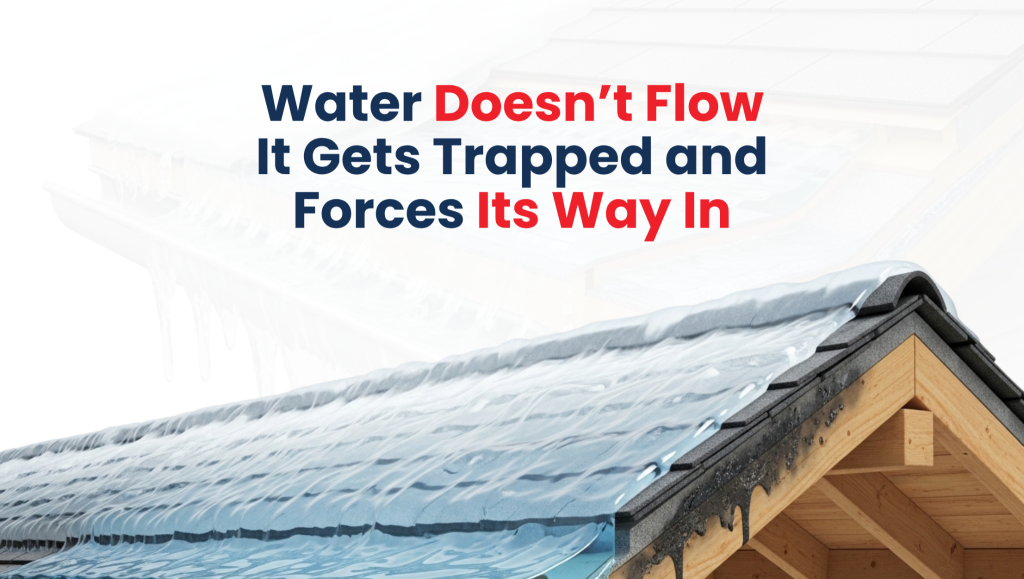
Ice dams deserve the most attention because they’re the most destructive winter roof problem NJ homeowners face, and the most misunderstood.
How do ice dams form?
An ice dam forms when heat escapes from your living space into the attic, warming the underside of the roof deck. That warmth melts the snow sitting on the roof above the heated area. The meltwater runs down the slope toward the colder eaves, which hang beyond the insulated living space and remain at or below freezing, where it refreezes.
Over days and weeks, that refrozen water builds into a ridge of ice at the eave. Meltwater from above continues to run down and can’t get past the ice dam, so it pools behind it. Pooled water doesn’t respect shingles the way flowing water does. It sits, seeps, and works its way under shingle tabs, through any gap in the underlayment, and into your home.
Also, Roofing Services Arlington, VA can help inspect roof insulation and ventilation issues that contribute to ice dam formation and water intrusion.
Why NJ Homes Are Particularly Vulnerable?
Ice dams form at the intersection of two conditions: a warm roof deck and cold eaves. New Jersey homes, particularly older construction in Bergen, Essex, Morris, and Passaic counties, often have:
- Attics are insulated to standards from decades ago, well below the current code.
- Recessed lighting that punctures the attic floor insulation barrier.
- Knee walls in finished attics are frequently under-insulated.
- Cathedral ceilings with minimal rafter depth for insulation.
All of these allow heat to escape into the attic space and warm the roof deck unevenly.
What Ice Dam Damage Looks Like Inside?
Ice dam leaks have a distinctive signature that separates them from other roof leaks:
- Water staining appears along exterior walls near the ceiling, not in the middle of the room.
- Staining often runs down the wall rather than spreading across the ceiling.
- Paint bubbles or peels along the top of exterior walls.
- Wet insulation compressed against the exterior wall in the attic.
- In severe cases, water drips from the junction between the ceiling and the exterior wall.
What makes ice dam leaks dangerous: By the time you see the interior signs, the water has often been entering for weeks. Ice dams don’t announce themselves with a dramatic drip; they seep slowly, and the damage accumulates in your wall cavity and insulation long before it’s visible on your drywall.
The Safe Way to Deal With an Active Ice Dam
If you have an ice dam right now, here’s what matters:
Do not hack at it with a hammer, chisel, or axe. This is the most common mistake NJ homeowners make, and it causes more damage than the ice dam itself to shingles, flashing, and gutters.
Do not use a standard roof rake while standing on the ground near the eave. Ice dam removal from the ground with a rake is only safe if you’re pulling snow back from the edge carefully and aren’t pulling ice chunks down on yourself or your gutters.
Calcium chloride ice melt in a nylon stocking laid perpendicular across the dam, running from the dam over the eave, creates a channel for meltwater to escape. This is a legitimate temporary measure. Do not use rock salt, which damages shingles and kills landscaping below.
Professional steam removal is the only method that safely removes a significant ice dam without damaging the roof. A hot steamer melts ice slowly and precisely without the impact damage that chipping causes. This is what our Ice Dam Repair NJ team uses.
Preventing Ice Dams Next Winter
The permanent solution to ice dams is an attic that stays cold, meaning heat from below doesn’t reach the roof deck. That requires two things working together:
Adequate insulation on the attic floor (or cathedral ceiling rafters) to keep heat in the living space where it belongs. In NJ, the current code calls for R-49 in attic floors for most climate zones.
Proper ventilation to flush any heat that does enter the attic out through ridge and soffit vents before it warms the deck. A cold, well-ventilated attic doesn’t form ice dams, even in the worst NJ winters.
Ice-and-water shield underlayment installed at the eaves adds a critical backup layer and is now required by the NJ building code for new construction and full replacements.
Snow Load: When Weight Becomes the Problem
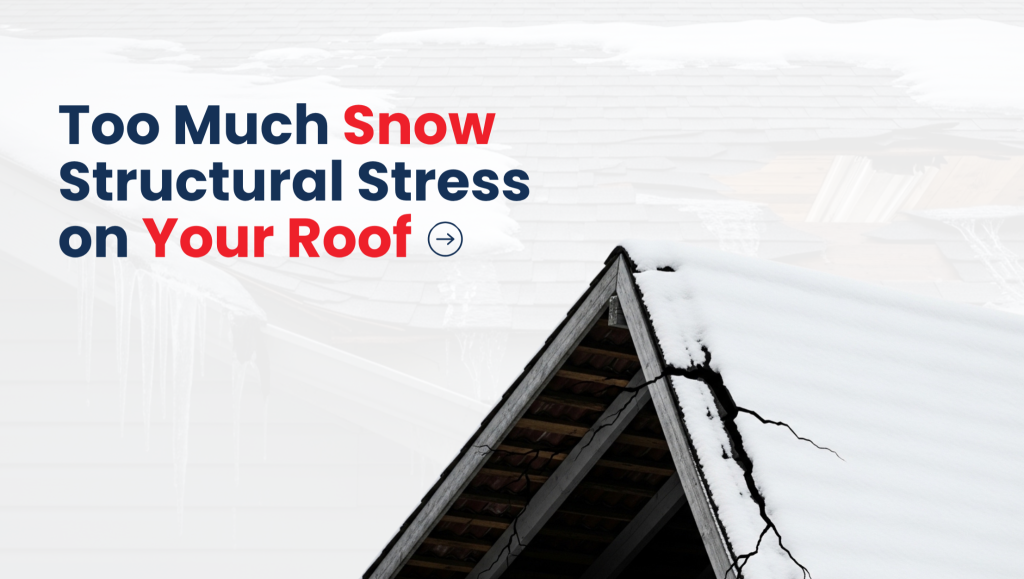
Most residential roofs in New Jersey are engineered to handle typical snow loads, but “typical” is doing a lot of work in that sentence. NJ has had winters with multiple back-to-back nor’easters that stacked 18, 24, and 36 inches of snow on roofs, with no time to shed the first storm before the second arrived.
How Much Snow Is Too Much?
Structural engineers generally use 20 pounds per square foot as a design threshold for residential roofs in NJ’s climate zone. Here’s what that translates to in snow depth:
- Fresh light snow: approximately 3 pounds per square foot per inch of depth.
- Wet, dense snow: approximately 8–12 pounds per square foot per inch of depth.
- Compressed snow with ice layers can exceed 20 pounds per square foot at 12–18 inches.
The danger zone for most NJ roofs begins around 2 feet of fresh snow or 12–18 inches of heavy, wet snow, especially if it’s sitting on top of ice from a previous storm.
Signs Your Roof Is Under Excessive Snow Load
- Creaking or popping sounds from the ceiling or attic indicate that the framing is under stress.
- Doors inside the home that suddenly stick or won’t close properly (frame racking).
- Visible deflection or sagging along the ridge line or between rafters.
- Cracks are appearing in the drywall near the ceiling, especially in corners.
If you hear sustained creaking or see visible deflection, leave the affected area of the house and call a structural engineer or contractor immediately. Snow load failure gives a limited warning.
Safe Snow Removal from NJ Roofs
A roof rake with a long telescoping handle, used from the ground, is the appropriate tool for removing snow from a single-story or low eave on a two-story home. Work from the eave upward, pulling snow down in sections. Do not try to remove all snow down to the shingle surface; leaving 2–3 inches protects the shingles from rake damage.
Never get on a snow-covered roof. The combination of snow, ice, and pitch makes it one of the most dangerous surfaces a person can stand on.
For roofs too steep or tall to safely rake from the ground, call a professional. The cost of snow removal is a fraction of the cost of a collapse or a hospital bill.
Freeze-Thaw Cycles: The Slow, Relentless Damage
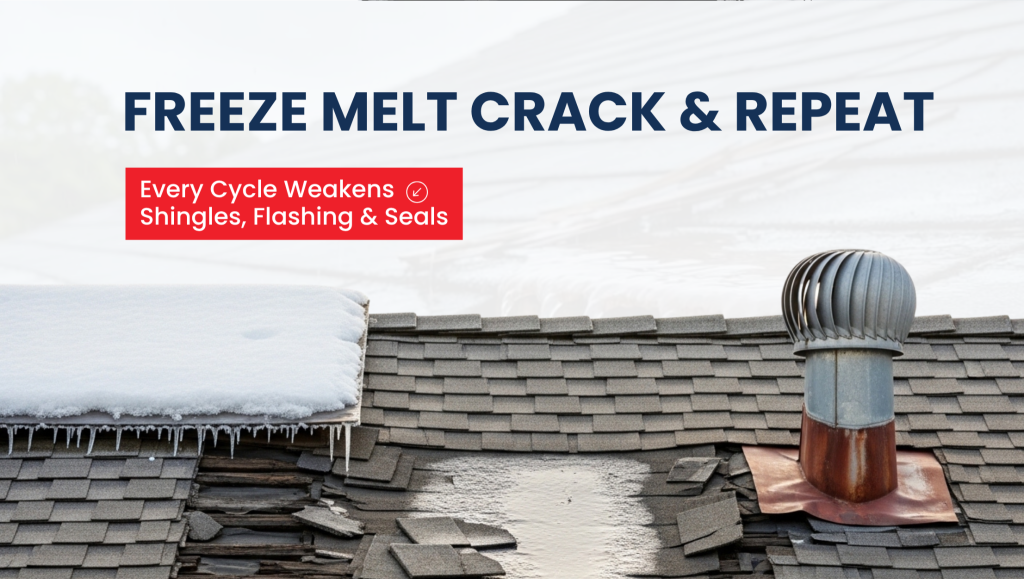
While ice dams get most of the attention, freeze-thaw damage is in some ways more insidious because it’s invisible and cumulative. Every freeze-thaw cycle puts stress on every component of your roof, and NJ can deliver 30 or more of these cycles in a single winter.
What Freeze-Thaw Does to Specific Roof Components
Shingle seals: Asphalt shingles have a factory-applied adhesive strip that bonds the shingle tab to the course below, creating a wind-resistant seal. Repeated freeze-thaw cycling breaks down this adhesive over time. Shingles that were sealed in September may have broken seals by February, leaving tabs free to lift in wind-driven rain.
Flashing joints: Metal flashing expands and contracts with temperature changes. Over multiple cycles, the sealant at flashing joints, where metal meets masonry or where step flashing meets a wall, cracks and pulls away, creating entry points that are nearly invisible until water is actively entering.
Chimney mortar: Mortar joints in brick chimneys absorb water, which then expands when it freezes. This spalls the mortar, breaking off small chunks each cycle, and can eventually open gaps large enough to allow direct water infiltration. A chimney that looked solid in October can have significant mortar joint damage by April. Our Chimney Leak Repair NJ page covers this in detail.
Gutters and fascia: Water sitting in gutters freezes, expands, and forces gutters away from the fascia. Bent or separated gutters pull the gutter spike or hidden hanger with them, sometimes taking fascia board material with it. Once the fascia is compromised, water enters the roof edge, one of the more damaging entry points because it affects the decking, the first course of shingles, and sometimes the wall below simultaneously.
Pipe boot flashings: The rubber collar around plumbing vent pipes becomes brittle and cracks in sustained cold. A boot that seals fine in summer may crack in the first hard freeze and begin leaking with the first thaw.
How to Spot Freeze-Thaw Damage After Winter
The best time to assess freeze-thaw damage is during the first dry stretch in late winter or early spring, February or March in most NJ years. Look for:
- Shingle tabs that lift in moderate wind are no longer sealed.
- Flashing that’s visibly pulled away from surfaces it should be tight against.
- Mortar joints on the chimney that look recessed, crumbled, or have visible gaps.
- Gutters that are sagging, separating from the fascia, or pulling at the corners.
- Pipe boot collars that are visibly cracked or pulling away from the pipe.
Catching these issues before the spring rain season begins is the difference between a minor preventive repair and dealing with the first major leak of the year in April.
Winter Roof Leaks Around Specific Structures
Skylights in Winter
Skylights develop leaks in winter through two different mechanisms that are easy to confuse:
True leaks occur when flashing at the skylight curb fails due to freeze-thaw cycling or when the sealant around the frame cracks in cold weather. These leaks happen during or immediately after precipitation.
Condensation occurs when warm, moist interior air contacts the cold skylight surface and forms water droplets that drip down into the room. This happens on cold, clear nights, not during rain, and is not a roof leak at all. It indicates a ventilation or humidity problem inside the home.
Telling them apart: if the “leak” happens during rain or snow melt, it’s a real leak. If it happens on cold, dry nights, it’s condensation.
Flat Roofs and Low-Slope Roofs in NJ Winters
Flat roofs face a compounded winter challenge. They can’t shed snow the way pitched roofs can, so snow accumulates, and the freeze-thaw cycle creates standing ice that sits directly on the membrane for extended periods.
EPDM rubber membranes become significantly less flexible in cold weather, making them more prone to cracking at seams and around penetrations. TPO and modified bitumen roofs handle cold better but still require inspection after hard freezes for seam separation and blister cracking.
If you have a flat roof on a commercial property, an addition, or a section of your NJ home, winter drainage is critical. A drain that’s frozen shut can cause ponding that stresses the membrane and, in extreme cases, the structure beneath. See our Flat Roof Leak Repair NJ page for winter-specific maintenance steps.
Metal Roofs in NJ Winters
Metal roofs are generally winter-resilient but have their own specific vulnerabilities. Thermal expansion and contraction on metal panels is more dramatic than on shingles; panels can move a significant amount over a temperature swing. If fasteners are improperly installed or the panel system doesn’t allow for movement, seams and fastener holes can open over time.
Snow and ice also slide off metal roofs faster than off shingle roofs, which means large sheets of ice can dislodge suddenly, damaging gutters, landscaping, or anything beneath the eave line. Snow guards are an important safety and protection feature on metal roofs in NJ. Our Metal Roof Leak Repair NJ page covers winter-specific issues for standing seam and exposed
