

A hidden leak slowly saturates roof decking until the wood softens, delaminates, and loses its ability to hold nails or bear weight, and by the time a stain appears on the ceiling, that process has usually been running for weeks or months already.
As a roof leak repair company based in New Jersey, we get called out to homes across Bergen, Passaic, Essex, and Morris counties specifically because this pattern repeats itself every single season here, and knowing what decking looks like at each stage of a hidden leak is a big part of how we diagnose the real problem instead of just patching the surface.
What Roof Decking Actually Does

Roof decking, sometimes called sheathing, is the flat wooden layer that sits directly on top of the rafters or trusses and underneath the underlayment and shingles.
Most homes in New Jersey use plywood or oriented strand board for this layer. It is not decorative, and it is not optional. It is the structural platform that everything else in the roofing system depends on.
The shingles shed water, the flashing seals the transitions, but the decking is what actually holds the whole assembly together and transfers the weight of snow, wind, and foot traffic down into the frame of the house.
When people talk about a roof “failing,” what they usually mean, without realizing it, is that the decking underneath has already given out.
How a Hidden Leak Actually Reaches the Decking
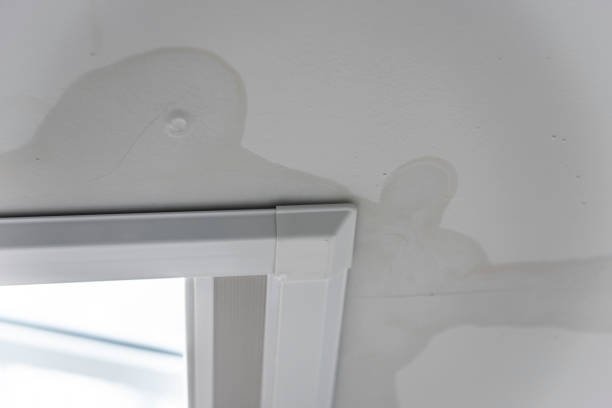
A leak rarely enters the exact spot where you eventually see a mark on your ceiling. Water follows the path of least resistance, which usually means it enters through a gap in flashing, a lifted shingle edge, or a cracked sealant joint, then travels sideways along the top of the decking or down a rafter before it ever shows up indoors.
This is why a leak near a chimney on the north side of a roof can produce a ceiling stain ten or fifteen feet away. The decking sits directly in that travel path, which means it is almost always the first structural material to absorb moisture, long before insulation, drywall, or paint ever reveal a problem.
The First Few Weeks: Moisture Absorption Nobody Notices
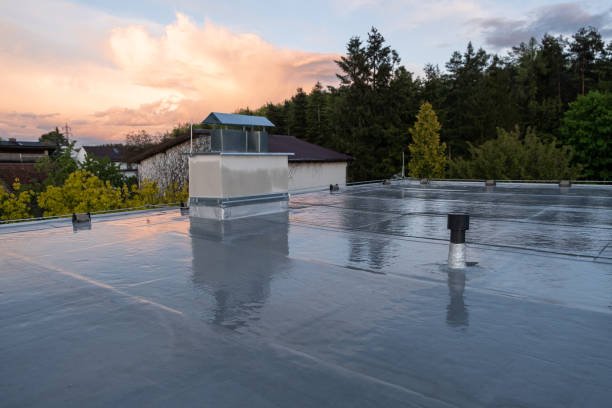
In the earliest stage, wood fibers in the decking begin absorbing moisture every time it rains, then partially drying between events. This cycle alone is enough to begin weakening the wood’s internal bond, even though nothing is yet visible from inside the attic.
Plywood and OSB are engineered from layered wood fibers held together with adhesive, and repeated wetting begins to break that adhesive bond well before any staining, softness, or smell becomes noticeable. A homeowner walking through the attic with a flashlight during this stage will typically see nothing out of the ordinary.
One to Three Months: Delamination and the Start of Decay
Once decking stays damp for more than a couple of days at a time, the layers inside plywood start to separate, a process called delamination.
On OSB, the wood strands begin to swell and lose their tight bond. Around the same timeframe, if moisture keeps returning without the wood ever fully drying, fungal organisms that cause wood decay begin to establish themselves.
This is usually the point where a musty smell starts to develop in the attic, and where dark staining becomes visible on the underside of the decking near rafters and nail heads. The wood is still structurally functional at this stage, but it is no longer performing the way it was engineered to.
Three Months and Beyond: Structural Softening
If the moisture source is never located and sealed, decay continues to spread outward from the original entry point.
The wood becomes soft and spongy to the touch, and fasteners that once held shingles firmly begin to back out or lose their grip entirely, because there is no longer solid wood fiber for them to bite into.
This is the stage where roofers start finding sections of decking that flex noticeably underfoot, or shingles that appear to sink slightly between the rafters below them. Left alone even longer, entire sections of decking can lose enough integrity that they are no longer considered safe to walk on without additional support.
Why This Damage Stays Hidden for So Long
Homeowners rarely see this progression because decking sits above the insulation and behind the roof covering, completely out of sight during a normal walkthrough.
The shingles on top can look completely normal from the ground even while the wood underneath is actively decaying, because the decay is happening on the interior face of the decking, not the exterior.
Add in the fact that attics are often unfinished, poorly lit, and rarely visited, and it becomes clear why so many decking problems are only discovered once a leak has already been active for a season or longer.
Signs That Point to Decking Damage Beneath the Surface
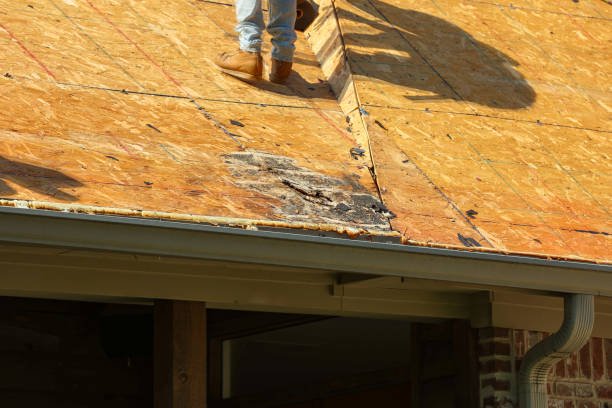
A few indicators tend to show up before decking damage becomes severe, and catching them early makes a real difference in the scope of repair needed.
Dark staining on the underside of the roof deck, especially concentrated around nail points or along a rafter line, usually means water has been sitting against that section repeatedly.
A musty or earthy smell in the attic that persists even on dry days is one of the more reliable early indicators of decay, since it points to organic breakdown happening somewhere in the wood.
Small pinpoints of daylight visible through the decking on a sunny day mean there is an actual gap or hole, not just surface moisture.
A slightly wavy or uneven roofline when viewed from across the street or yard often means a section of decking underneath has softened and is no longer holding its shape properly.
Nail pops or shingles that appear loose in a specific area, without obvious storm damage nearby, frequently trace back to decking that has lost its ability to grip fasteners.
Why New Jersey Homes See This Pattern So Often
New Jersey’s climate puts decking under a particular kind of pressure that a lot of other regions do not deal with in the same combination.
Winters bring repeated freezing and thawing, which lets ice dams form at the eaves and push meltwater backward under the shingle line, right onto the decking. Humid summers accelerate the breakdown of sealants and shingle granules, opening small entry points that widen with each storm.
Fall brings heavy leaf debris into gutters across the state’s dense tree canopy, and clogged gutters push overflow directly against the lowest run of decking at the roof edge.
Because these conditions repeat every year, the same decking assemblies in New Jersey homes face far more wet and dry cycles over their lifespan than decking in drier or more stable climates, which is exactly why decay tends to show up here on a shorter timeline than the industry average.
What a Professional Inspection Finds That a Visual Check Cannot
A flashlight and a ladder can only tell you so much. Calibrated moisture meters read the actual water content inside the wood fibers, which allows a trained inspector to map how far moisture has spread across the decking, even in sections that look completely dry to the eye.
Wood sitting at a healthy moisture level reads very differently on a meter than wood that has been repeatedly saturated, long before either one shows a visible sign. As a roof leak repair team working across New Jersey for over a decade, this is a big part of why we lead every inspection with attic moisture mapping instead of a surface walk.
We have seen too many cases where a homeowner’s own inspection missed decking damage sitting just a few feet from where they were standing, simply because moisture inside wood does not always announce itself the way people expect it to.
The Bottom Line
A hidden leak does not wait for you to notice it before it starts affecting your roof decking. The damage begins quietly, at the fiber level, long before staining, smells, or soft spots give it away, and by the time those signs are obvious, the decking has usually already gone through several stages of decline.
Understanding this timeline is useful for any homeowner, whether the goal is catching a problem early, evaluating a contractor’s findings, or simply knowing what questions to ask during an inspection.
Related: Why Is My Attic Insulation Wet When I Cannot See an Active Roof Leak?
FAQs
What is the difference between roof decking and roof sheathing?
Roof decking and roof sheathing refer to the same structural layer, the wood surface, usually plywood or oriented strand board, that sits on top of the rafters and beneath the underlayment and shingles. “Decking” is the more common term in the Northeast, while “sheathing” is used more often in manufacturer literature and building codes, but both describe the exact same component.
Does replacing shingles alone fix rotted decking underneath?
No. New shingles only address the surface layer and do nothing for wood that has already softened or delaminated beneath them. Installing new roofing material over compromised decking usually shortens the lifespan of the new shingles, since fasteners cannot grip properly into weakened wood, and the rot continues to spread underneath the new layer.
Can damaged roof decking be repaired, or does it always need full replacement?
It depends on how far the decay has spread. A small, isolated section of soft or delaminated decking can often be cut out and replaced with a matching patch tied into the surrounding rafters. Once decay covers a wider area or the wood has lost its ability to hold fasteners, replacing the full section becomes the more reliable option.
Is it safe to walk on a roof if the decking underneath may be rotted?
Not without caution. Rotted decking loses its load bearing strength, and a section that looks solid from above can still give way underfoot. Anyone who suspects decking damage, from soft spots, sagging, or a spongy feel when walking near the roofline, should treat that area as unstable until it has been checked from the attic side.
How can a roofer tell if decking damage is from an old leak or a recent one?
Older decay tends to show darker, more uniform staining with a dry, crumbly texture, while a newer leak produces lighter staining that still feels damp or soft to the touch. Moisture readings also help separate the two, since wood affected by a leak from months ago often reads differently than wood that took on water within the past few days.