 Skip to content
Ignoring a roof leak, even a small one, leads to structural wood rot, mold growth, damaged insulation, failed ceilings, and in serious cases, compromised rafters and wall framing. What costs a few hundred dollars to fix today can turn into a $10,000–$50,000 repair bill within months if left unaddressed.
Most homeowners don’t ignore roof leaks on purpose. They put a bucket down, tell themselves they’ll deal with it after the holidays, after the kids go back to school, after the busy season at work. And then one morning, the ceiling tile collapses into the living room, or the insurance adjuster tells them that mold damage isn’t covered because the leak was clearly ongoing for over a year.
This guide walks through exactly what happens, stage by stage, when a roof leak goes untreated in a New Jersey home. The timeline is faster than most people expect.
The 6 Stages of Ignored Roof Leak Damage
Understanding how damage progresses helps you understand why speed matters so much. A leak doesn’t stay contained; it spreads, and each stage makes the next one worse.
Stage 1: The Attic Takes the First Hit (Days 1–7)
The first place roof water goes is your attic, and most homeowners never see it happening because they don’t go up there regularly.
Within the first week of an active leak, attic insulation begins absorbing water. Wet insulation loses its R-value almost immediately, meaning your home starts losing heat efficiency even before you notice a ceiling stain. In winter, this shows up fast on your heating bill. In summer, your cooling costs spike.
Beyond the insulation, the attic framing, rafters, collar ties, and ridge boards begin absorbing moisture. Wood can tolerate brief exposure, but even a week of consistent dripping starts the softening process that eventually leads to rot.
What NJ homeowners often see at this stage: A musty smell coming from the ceiling or upper floor, especially after rain. Some people chalk this up to “old house smell.” It’s not. It’s wet wood. Also, for professional assessment and repair guidance, Houston Roofing Company can help identify and address the early signs of roof leaks before they turn into structural damage.
Stage 2: Ceiling Stains and Drywall Damage (Weeks 1–4)
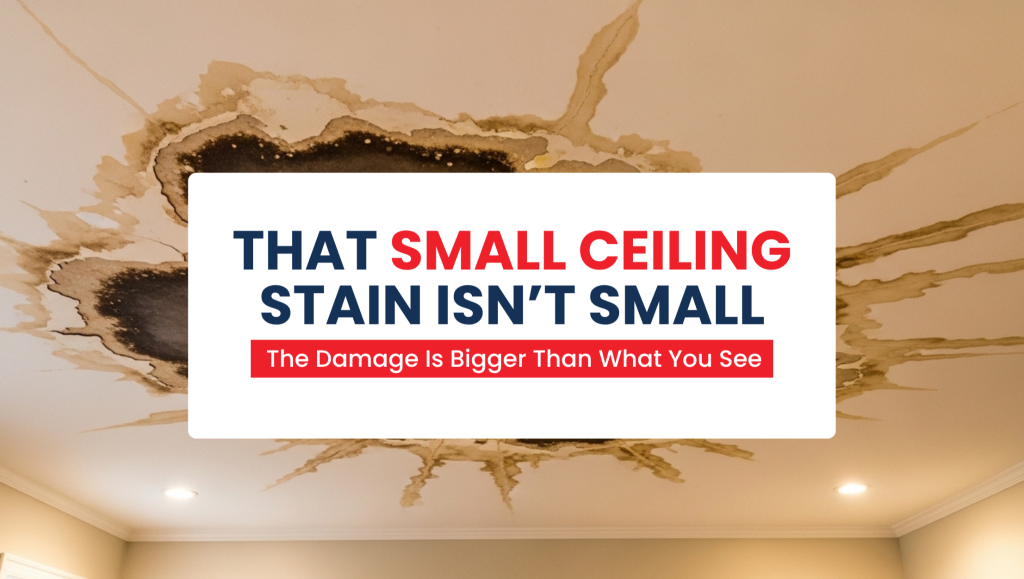
This is usually when homeowners first notice something is wrong: a yellowish-brown ring on the ceiling, a bubble in the paint, or a soft spot in drywall.
What you’re seeing at this point is water that has already traveled through the roof deck, soaked the insulation, and now saturated the ceiling material below.
The stain you see represents the outer edge of water that has spread outward from the drip point, meaning the actual wet zone is larger than the visible stain.
Drywall that gets wet loses structural integrity quickly. It crumbles, sags, and if it gets wet repeatedly, as it will with every rainstorm, it never fully dries out. That creates a permanent moisture reservoir that feeds mold growth even during dry periods.
Real NJ scenario: A homeowner in Bergen County noticed a small ceiling stain in February after a nor’easter. They wiped it down and assumed the storm was a one-time event.
By April, after two more rain events, the stain had tripled in size, the drywall was soft to the touch, and mold was visible along the edge of the stain. What would have been a $600 flashing repair in February became a $4,200 job that included drywall replacement and mold remediation.
The biggest mistake homeowners make is waiting for visible interior damage before taking action. Roof leaks rarely stay isolated, and the longer moisture remains trapped inside the structure, the more expensive the repairs become.
If you notice early warning signs like ceiling stains, musty odors, or unexplained moisture after rain, consulting experienced professionals for Roof Repair Services in Burbank, CA can help prevent minor leaks from turning into major structural and mold-related problems.
Stage 3: Mold Takes Hold (Weeks 2–6)
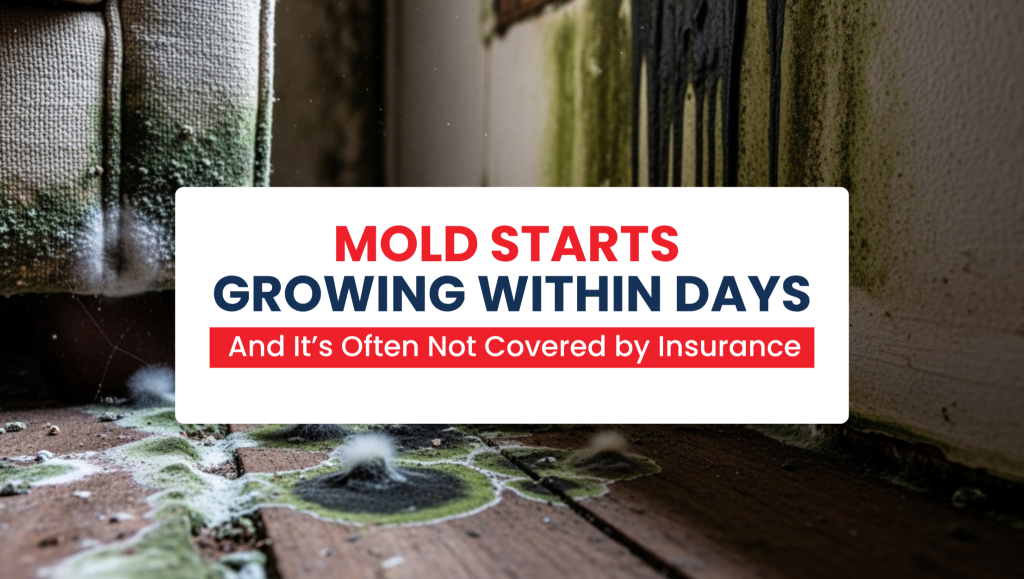
This is the stage that turns a roofing problem into a health problem, and it happens faster than most people realize.
Mold needs three things: moisture, a food source, and the right temperature. Your attic and ceiling cavity provide all three. Once the relative humidity in a wet attic exceeds 60%, which happens quickly after a leak, mold spores that are naturally present in every home begin colonizing within 24 to 48 hours on wet surfaces.
Black mold (Stachybotrys chartarum) is the species most associated with water-damaged homes and the one most likely to cause respiratory symptoms, headaches, and chronic health issues. It thrives on wet drywall, wood framing, and insulation, exactly the materials a roof leak saturates.
Why this matters financially: Most homeowners’ insurance policies in NJ cover mold remediation only if the mold resulted from a covered sudden event, not from an ongoing leak that was left untreated. If an adjuster determines the mold developed over weeks or months from a known leak, they can and often will deny the mold portion of the claim entirely.
Mold remediation in a New Jersey home typically costs $2,000–$6,000 for a contained attic area. If mold has spread into wall cavities or living spaces, costs can easily reach $15,000 or more.
Stage 4: Insulation Failure and Energy Costs (Weeks 3–8)
Saturated insulation doesn’t just lose effectiveness; it compacts, collapses, and in some cases develops its own mold colony independent of the ceiling below. Fiberglass batts that have been repeatedly soaked lose their loft permanently. They do not bounce back when they dry out.
Blown-in cellulose insulation, common in older NJ homes, clumps into dense, useless masses when wet and can hold moisture for weeks, creating a sustained damp environment that keeps feeding mold growth long after the leak itself has been repaired.
The hidden cost most homeowners miss: Insulation replacement after water damage is rarely covered by insurance if the underlying leak was ignored. You’re paying for new insulation out of pocket on top of the roof repair, typically $1,500–$4,000, depending on attic size and insulation type.
Stage 5: Structural Wood Rot (Months 1–6)
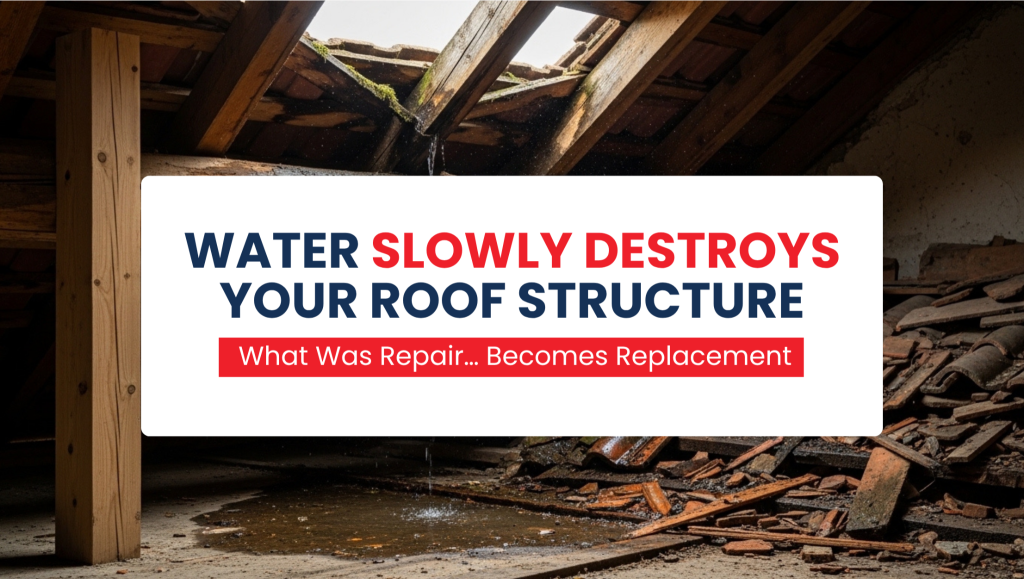
This is where an ignored roof leak crosses the line from a repair problem to a structural problem, and where costs become genuinely serious.
Wood rot is caused by fungi that digest the cellulose in wood. It needs sustained moisture to establish, which is exactly what an ongoing leak provides. Once rot sets in, it spreads through contact.
A rotted rafter end can spread to adjacent framing, a rotted fascia board works its way into the soffit, and then the wall sheathing.
In New Jersey’s climate, the freeze-thaw cycle accelerates this process. Water in partially rotted wood expands when it freezes, cracking and splitting wood fibers further with every cycle. What begins as soft spots at leak entry points can spread to encompass full rafter sections within a single winter.
Signs of structural rot NJ homeowners can watch for:
- Roofline that appears to sag or dip between rafters.
- Soft or spongy feeling when walking on the roof.
- Fascia boards that look discolored, crumbling, or have visible holes.
- Visible daylight through the decking when viewed from the attic.
Replacing individual rafters or sections of decking runs $1,500–$5,000. Replacing significant portions of the roof structure when rot has spread can run $15,000–$30,000 or more, and that’s before you put a new roof on top of it.
Real NJ scenario: A homeowner in Morris County bought a house in the spring with a minor ceiling stain that the seller disclosed. They planned to fix the roof “when the budget allowed.” By the following spring, one full year later, two rafters had rotted through completely, and the decking over a 12-foot section was soft. The repair scope had grown from replacing flashing and a few shingles to partial rafter sistering, full decking replacement over one slope, and a new roof. Total cost: just over $22,000.
Related: How to Choose a Roof Leak Repair Contractor in NJ?
Stage 6: Electrical Hazards and Ceiling Collapse (Months 3–12+)
Water and electricity are a dangerous combination, and most attics and ceiling cavities contain wiring. When water tracks along insulation and drips onto junction boxes, runs along wiring, or soaks into areas near recessed lighting, it creates genuine fire and electrocution hazards that go well beyond the roofing problem.
Signs water has reached your electrical system:
- Flickering lights in the area of the leak.
- Discoloration or rust around ceiling light fixtures.
- Breakers tripping repeatedly in a specific zone.
- A burning or ozone smell near the affected area.
If you see any of these signs, stop using the circuits in that area and call an electrician immediately. This is not a wait-and-see situation.
Ceiling collapse happens when drywall has absorbed enough water that its weight exceeds what the paper facing and joint compound can hold. It rarely happens without warning; the sag and softness come first, but when it goes, it goes fast and takes everything saturated above it with it.
Real NJ scenario: A rental property owner in Passaic County had a tenant report a small drip near a bedroom ceiling light. The owner scheduled a repair for “the following week.” Four days later, a section of ceiling approximately four feet by three feet collapsed into the bedroom, fortunately while the tenant was in another room.
The collapse exposed saturated insulation, visibly wet wiring in the ceiling cavity, and mold on the drywall and subfloor above. Total repair cost, including electrical, drywall, mold remediation, and roofing: $18,500. The tenant broke their lease, and the owner faced a habitability complaint.
The Real Cost of Waiting: A Side-by-Side Comparison
| Fix it immediately | Wait 3–6 months |
| Flashing repair: $400–$800 | Flashing + drywall + mold: $4,000–$8,000 |
| Shingle replacement: $300–$700 | Shingles + decking + insulation: $5,000–$12,000 |
| Pipe boot seal: $150–$300 | Pipe boot + rafter repair + remediation: $8,000–$20,000 |
| Chimney flashing: $500–$1,200 | Chimney + structural + mold: $10,000–$30,000 |
These aren’t worst-case numbers. These are representative of what NJ roofers and remediation companies see routinely.
What About Insurance? Does Waiting Hurt Your Claim?
Yes, significantly. This is one of the most important practical consequences of delaying a roof repair that NJ homeowners overlook.
Homeowners insurance in New Jersey covers sudden and accidental damage. The moment an adjuster determines that a leak was ongoing and ignored, they reclassify it from a covered event to a maintenance failure. That distinction costs you the entire claim, not just part of it.
Insurance companies look for:
- Water staining that shows multiple tide marks (evidence of repeated wetting and drying)
- Mold growth, which indicates moisture over weeks or months
- Wood rot, which doesn’t happen overnight
- Photographs that show deterioration inconsistent with a recent event
If you have a leak right now and you’re considering whether to file a claim, read our full guide on whether roof leak repair is covered by homeowners’ insurance in NJ before you call your insurer. Timing and documentation matter enormously.
“But My Leak Is Really Small.” Why Small Leaks Are Deceptive?
A small drip is a symptom, not the full picture. By the time water is dripping visibly into your living space, it has already:
- Passed through the roof covering (shingles or membrane).
- Soaked through the underlayment.
- Saturated at least part of the decking.
- Traveled along a rafter or ceiling joist.
- Saturated insulation along its path.
- Penetrated the ceiling material.
Every drip you see represents a much larger volume of water that is absorbed into materials before it reaches the visible drip point. A “small” leak producing one drip per minute over a week delivers roughly 10,000 drips ,and most of that water never makes it to your bucket. It sits in your insulation, your drywall, and your wood framing.
When to Act, And How Fast?
There is no version of a roof leak where waiting is the right answer. But here’s a realistic priority framework:
Act within 24 hours if:
- Water is dripping near any electrical fixture or panel.
- The ceiling is visibly sagging or bubbling significantly.
- You can see daylight through the roof from the attic.
- Water is entering during an active storm with no sign of stopping.
Act within 72 hours if:
- You have a visible ceiling stain that appeared after a rain event.
- You must smell mustiness in the ceiling area after rain.
- A ceiling stain is growing between rain events.
Schedule within 1–2 weeks if:
- You see a small, stable stain that hasn’t grown.
- You identified a minor issue (granule loss, a cracked shingle) during a roof inspection.
- You’re seeing early signs of flashing wear without active leaking.
Our Emergency Roof Leak Repair NJ page covers what to do right now if you’re in the first category.
Related post: How Snow & Freeze-Thaw Cycles Damage Roofs in NJ?
The Bottom Line
Every week you wait for a roof leak is a week water spends inside your home’s structure. The progression from drip to mold to rot to structural failure follows a predictable path, and the cost multiplies at every stage.
The three real-life NJ examples in this guide aren’t edge cases. They’re the kinds of calls roofers and remediation companies across Bergen, Morris, and Passaic counties get every month. A leak that would have cost a few hundred dollars in September becomes a five-figure project by spring.
If you have a leak or even suspect one, the right time to act is now, not after the next storm confirms it.
Content provided by NJ Roof Leak Experts
