
You need a roof repair — not a replacement — if the damage is isolated to a specific area, your roof is under 15 years old, and the underlying decking and structure are sound. However, if water has penetrated the decking, insulation, drywall, or framing, the damage may extend beyond the roof itself and could require professional mold remediation alongside moisture-damaged material repairs. You need a full replacement if your roof is over 20 years old, has widespread damage across multiple sections, or has repeated leaks that repairs haven’t resolved permanently.
That’s the honest starting point. But the real answer for your specific roof depends on five factors that no blog post, and no contractor standing in your driveway, can determine without a proper inspection.
This guide gives you the framework to understand those factors, ask the right questions, and avoid the two most expensive mistakes NJ homeowners make: replacing a roof that didn’t need it, and repairing a roof that did.
Why Does This Decision Matter More in NJ Than Most States?
New Jersey’s climate is genuinely tough on roofing systems. The combination of nor’easters, ice dams, freeze-thaw cycles, humid summers, and occasional hurricane remnants means NJ roofs age faster and take more cumulative damage than roofs in more temperate climates.
That climate reality cuts both ways in this decision. It means a 12-year-old roof that’s been through several hard winters may have sustained more effective aging than a 12-year-old roof in a milder climate. It also means a well-maintained roof with quality materials can last significantly longer than its rated lifespan — meaning replacement isn’t always the answer just because a roof is getting older.
The right answer is never based on age alone. It’s based on condition, and the condition requires inspection.
The 5 Factors That Determine Repair vs. Replacement
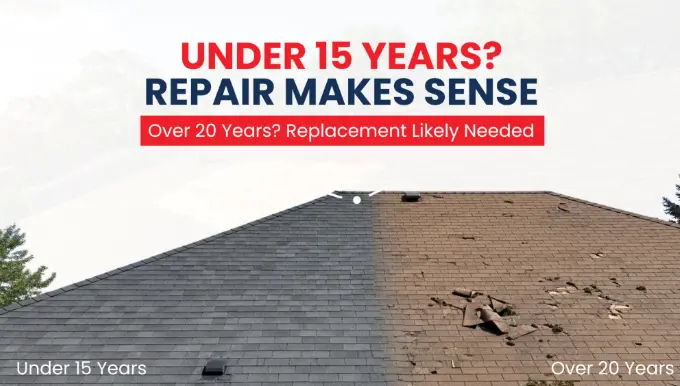
Factor 1: The Age of Your Roof
Age is the most commonly cited factor – and the most commonly misapplied one. Here’s how to think about it correctly.
Standard asphalt shingle roofs in NJ have an effective lifespan of roughly 20–25 years under normal conditions. “Normal” in NJ means regular maintenance, adequate ventilation, and no catastrophic damage events.
Under 10 years old: Repair almost always makes sense unless installation was seriously defective. A roof this age has most of its functional life ahead of it. Even significant damage to a section is usually worth repairing.
10–15 years old: Repair is still usually the right call for isolated damage. Pay attention to the overall condition of the rest of the roof — if the damaged section is an outlier on an otherwise healthy roof, repair it. If the damaged section is representative of how the whole roof looks, start thinking about the replacement timeline.
15–20 years old: This is the gray zone where the repair-versus-replace decision gets genuinely complex. A roof in this age range may have 5–10 years of life remaining if it’s in good shape — or it may be at the end of life. Condition matters more than age here. Get a thorough inspection and an honest second opinion.
Over 20 years old: Replacement becomes the more likely right answer — but not automatically. A 22-year-old roof with quality shingles, solid ventilation, intact flashing, and only isolated damage from a specific storm event may still be worth repairing if the rest of the system is sound. A 20-year-old roof with widespread granule loss, multiple soft spots in the decking, and a third round of repairs on the same section probably isn’t.
Factor 2: The Extent and Location of the Damage
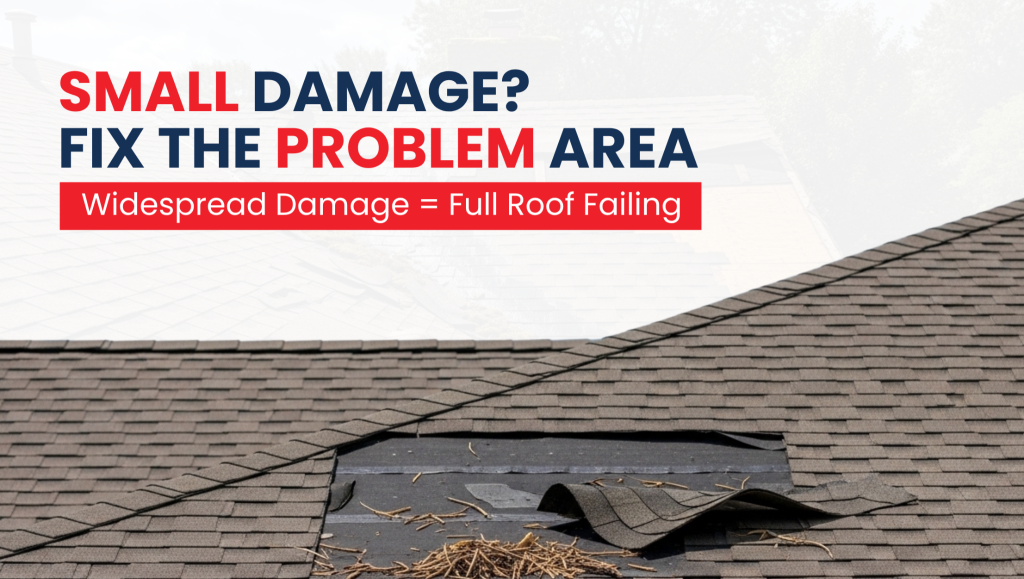
This is where the physical inspection matters most. Two questions drive this factor: how much of the roof is affected, and where is the damage located?
Isolated damage — strong case for repair:
If the damage is confined to a clearly defined area — one section of flashing around a chimney, a cluster of shingles on a north-facing slope, a single pipe boot — and the surrounding material is in good condition, repair is almost always the right call. You’re addressing a specific failure point, not a systemic problem.
Widespread damage — stronger case for replacement:
If an inspector finds damage across multiple sections — granule loss across two slopes, soft spots in the decking in three locations, flashing failures at the chimney and two valleys simultaneously — the roof is telling you something different. Widespread simultaneous failures across unrelated areas indicate a roof that has reached the end of its life, not a roof that had one bad event.
Location matters too:
Damage at a transition point — chimney flashing, valley, skylight — is almost always repairable regardless of age, because these are mechanical failure points that can be replaced independently. Damage to the field of the roof — the broad, flat shingle surface — is more diagnostic. Widespread field damage means the material itself is failing, which points toward replacement.
Factor 3: The Condition of the Roof Decking
This factor overrides everything else. If your roof decking — the plywood or OSB sheathing that everything else sits on — is compromised, repair becomes significantly more complicated and expensive regardless of how old the roof is or how isolated the visible damage appears.
Signs of decking problems:
- Soft or spongy feeling when walking on the roof — indicates rot or delamination in the sheathing beneath.
- Visible sagging or dipping between rafters when viewed from the ground.
- Rafters or decking that show active rot when inspected from the attic.
- Multiple layers of old roofing material are already on the roof — NJ building code allows a maximum of two layers of shingles; if there are already two, any new work requires a full tear-off.
Why does this matter for the repair-replace decision?
A repair over damaged decking isn’t really a repair; it’s new roofing material applied over a compromised foundation. The repair will fail prematurely, you’ll pay for it again, and you’ll have wasted the repair cost. If decking replacement is required over more than 20–30% of the roof area, the economics shift decisively toward full replacement.
Related: Why Does My NJ Roof Only Leak During a Nor’easter? (The Science of Horizontal Rain)
Factor 4: Repair History — How Many Times Has This Roof Been Fixed?
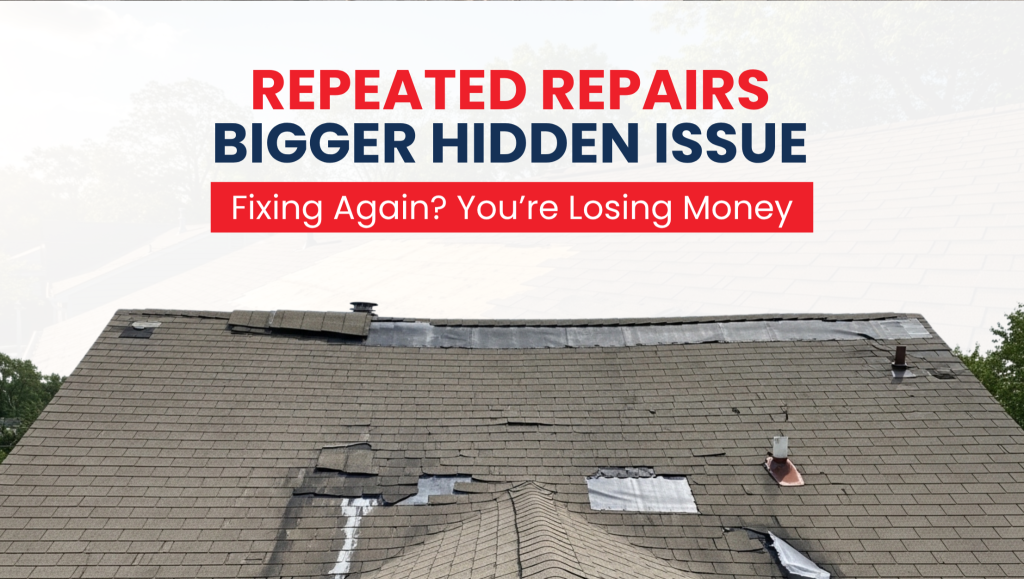
Every repair tells a story, and a roof with a long repair history is telling you something important.
One or two targeted repairs over the life of a roof are completely normal. Flashing around a chimney gets replaced, a section of shingles damaged by a fallen branch gets patched — these are maintenance events, not warning signs.
But a roof that has been repaired in the same area twice, or has had multiple repairs across different sections in a short period, is showing you a pattern. That pattern usually means one of two things: the repairs weren’t addressing the actual root cause, or the roof material itself is at a stage of deterioration where failure is happening faster than targeted repairs can keep up with.
The “repair treadmill” is a real and expensive trap. If you’ve spent $1,800 on repairs in the last three years on a 17-year-old roof and it’s still leaking, that money is gone — and the roof still needs to be replaced. A roofer who gives you an honest replacement recommendation at year one of that cycle saves you more money than one who keeps repairing.
This is also relevant for insurance purposes. An adjuster who sees a documented history of repeated repairs in the same area may use that history to argue pre-existing conditions and deny a storm damage claim. Our guide on whether roof leak repair is covered by homeowners’ insurance in NJ covers this dynamic in detail.
Factor 5: Your Plans for the Property
This factor is practical and personal — and it belongs in the conversation.
If you’re planning to sell within 2–3 years, A full roof replacement has a strong ROI in the NJ real estate market. A new roof is a significant selling point, eliminates the inspection negotiation around roofing condition, and in many cases allows you to recover 60–70% of the replacement cost in the sale price. A patch repair on an aging roof may satisfy a buyer’s inspector — or it may not, leaving you in a renegotiation you didn’t anticipate.
If you’re staying long-term: The calculus is different. If a quality repair extends your roof’s functional life by 5–7 years and costs $1,200, versus a $15,000 replacement, you could defer the repair if it makes financial sense as long as the rest of the system is sound.
If it’s a rental or investment property: Factor in tenant impact, habitability requirements, and long-term maintenance costs over the rent roll. A roof that requires annual repairs is a management headache and a liability exposure. Sometimes replacement is the better business decision, even when repair is technically possible.
The Cost Comparison: What You’re Actually Choosing Between
Understanding the financial picture clarifies the decision considerably.
Typical roof repair costs in NJ:
- Isolated flashing repair: $400–$1,500.
- Shingle section replacement: $300–$900.
- Pipe boot replacement: $150–$350.
- Valley repair: $500–$1,500.
- Chimney flashing: $500–$1,800.
- Partial decking replacement: $1,000–$3,500.
Typical full roof replacement costs in NJ:
- Small home (under 1,500 sq ft): $8,000–$14,000
- Mid-size home (1,500–2,500 sq ft): $12,000–$22,000
- Larger home (2,500+ sq ft): $20,000–$40,000+
These ranges reflect standard three-tab or architectural asphalt shingles with tear-off of one layer. Metal roofing, premium shingles, steep pitches, and complex roof geometry all push costs higher.
The break-even framework:
A useful rule of thumb — if the cost of repair exceeds 30% of the cost of full replacement on a roof that’s in the second half of its lifespan, replacement is almost always the better financial decision. You’re spending significant money to extend a roof that is already aging, and you’ll be back in the same conversation within a few years.
See our full breakdown on how much roof leak repair costs in NJ for detailed pricing by repair type.
What Contractors Sometimes Get Wrong — And Why It Costs You?
This section matters because the repair-versus-replace recommendation you get is only as good as the contractor giving it.
The replacement bias: Some contractors — particularly larger companies with strong replacement crews and sales incentives — lean toward recommending replacement more often than the roof’s condition actually warrants. A new roof is a larger job, a larger margin, and a cleaner outcome for them. This doesn’t make every replacement recommendation wrong — but it’s worth getting a second opinion on any replacement recommendation for a roof under 18 years old.
The repair bias: On the other side, contractors who specialize in repairs — or who want to give you a lower number to win the job — sometimes recommend repairs that genuinely don’t address the full problem. Three targeted repairs over two years on a roof that needed replacement from the start is expensive for you and profitable for them.
What does an honest assessment look like?
A trustworthy contractor inspects the attic, walks the roof surface, assesses decking condition, reviews repair history, and gives you a written recommendation that explains the reasoning — not just the price. They tell you the repair option and the replacement option and let you make an informed decision.
If a contractor won’t go in the attic, gives you a number without walking the roof, or can’t explain why they’re recommending what they’re recommending — that’s a red flag. Our full guide on how to choose a roof leak repair contractor in NJ walks through exactly what to look for.
Specific Scenarios: Repair or Replace?
Scenario 1: Storm damage to one slope on a 10-year-old roof. Repair. Isolated storm damage on a young roof with otherwise sound condition is exactly what repair is for. Document the damage thoroughly for an insurance claim.
Scenario 2: Recurring leak around the chimney on a 16-year-old roof. Inspect before deciding. If the chimney flashing has failed and the rest of the roof is in good shape, a flashing replacement is appropriate. If the broader roof shows widespread aging, the chimney leak may be the first of several failures coming in quick succession — factor that into the decision.
Scenario 3: Multiple leaks in different locations on a 19-year-old roof. Replacement is the likely right answer. Multiple simultaneous failures across unrelated locations on an aging roof indicate systemic material failure, not isolated events.
Scenario 4: A newly purchased home with an unknown roof history and visible ceiling stains. Get a full professional inspection before committing to either path. You need to know the age, the repair history, the decking condition, and the extent of existing damage before any money changes hands.
Scenario 5: A 12-year-old roof with two failed pipe boots and granule loss on one section Repair — but make sure the roofer checks the full roof surface while they’re up there. Two pipe boots and a granule loss section on a 12-year-old roof is manageable, but you want a complete picture.
Scenario 6: Flat roof on an addition with bubbling membrane and multiple small leaks This depends heavily on how much of the membrane is affected. Spot repairs on a flat roof membrane can extend its life significantly if less than 25% of the surface is compromised. If bubbling and seam failures are widespread, replacement of the membrane is more economical than repeated spot repairs.
Questions to Ask Before You Decide
Use these when you’re talking to a roofer:
- What is the current estimated remaining lifespan of this roof, based on what you’re seeing?
- Is the damage isolated, or do you see similar deterioration across other sections?
- What is the condition of the decking — is any replacement required?
- How many layers of roofing material are currently on the roof?
- If I repair now, what’s your honest estimate of how long before I’m back in this conversation?
- What would a full replacement cost versus the repair you’re recommending?
- Is the repair you’re recommending likely to affect my manufacturer’s warranty?
- What would you do if this were your house?
That last question is the most revealing. A contractor who gives you a different answer than what they’re quoting you has just told you something important.
How Insurance Factors Into This Decision?
If your leak or damage was caused by a storm, wind, hail, or another covered peril, your insurance company has a stake in this decision, too.
For repair claims, insurers typically pay for the damaged section only — not the full roof. For replacement claims on roofs damaged by a covered peril, they may pay for full replacement if the damage is extensive enough and your policy covers Replacement Cost Value rather than Actual Cash Value.
The age of your roof affects what insurance pays. A 20-year-old roof on an ACV policy may receive a settlement that covers only a fraction of replacement cost after depreciation is applied. Understanding your policy before you decide between repair and replacement can significantly affect the financial outcome.
Read our full guide on whether roof leak repair is covered by homeowners’ insurance in NJ before you file anything.
Helpful Pages on NJRoofLeakExperts
- Roof Leak Repair NJ — What a professional repair process looks like.
- Emergency Roof Leak Repair NJ — If the leak is active while you’re making this decision.
- How to Find the Source of a Roof Leak in Your NJ Home — Locate the entry point before committing to repair or replace.
- Why Is My Roof Leaking? 10 Most Common Causes in NJ — Understanding the cause shapes whether it’s a repair or a systemic problem.
- What Happens If You Ignore a Roof Leak? — What’s at stake while you delay the repair-or-replace decision?
- Roof Flashing Repair NJ — Often repairable independently, regardless of overall roof age.
- Chimney Leak Repair NJ — Chimney failures are frequently repairable, even on older roofs.
- Flat Roof Leak Repair NJ — Repair-versus-replace calculus is different for flat roofs.
- Metal Roof Leak Repair NJ — Metal roofs have a longer lifespan; repair is often viable further into the roof’s life.
- How Much Does Roof Leak Repair Cost in NJ? — Know both numbers before you decide
- How to Choose a Roof Leak Repair Contractor in NJ? — The recommendation you get is only as good as the contractor giving it.
The Bottom Line
Repair or replace comes down to five things: age, extent of damage, decking condition, repair history, and your plans for the property. No single factor decides it — they work together.
A 14-year-old roof with isolated flashing damage and solid decking gets repaired. A 21-year-old roof with granule loss across three slopes, soft spots in two decking sections, and a third leak in four years gets replaced. Everything in between requires an honest inspection and an honest conversation with a contractor who isn’t financially incentivized to push you one way or the other.
Get the inspection in writing. Get a second opinion if the recommendation surprises you. And don’t let the decision sit — a roof that needs replacing doesn’t get cheaper to replace, and every season you delay is another season of potential water damage accumulating inside your home.